junio 16, 2008

Global Urban Development Trends in Santo Domingo

Global Urban Development Trends in Santo Domingo
A simple overview after an essay by Eleonora Peruffo

Planning practices in developed and developing countries have been evolving and after the failure of many Master Plans in the 80s the planning methods have switched to Strategic Planning and Participatory Planning. These two options generally look forward to empowering local authorities and citizens in order to shape together the “city vision”. However, in developed and developing countries these plans don’t achieve the complete bulk of their objectives and some global trends have been studied.

In the “recently” split Santo Domingo these trends –stated by E. Peruffo– can be identified easily because of the unclearness of responsibilities, the cleverness of powerful privates and other reasons.


Market Oriented Development
It is often said by privates that planning is a constraint on economic/urban development and recent Listin Diario newspaper articles have confirmed this opinion by publishing their negative opinions on a project approval’s time by the authorities. Nevertheless the construction sector is one of the most important in Santo Domingo, and it’s a common practice by privates to fool authorities with fake plans and/or just begin the construction works before approval.

These two “common practices” produce an irregular urban sprawl that has been translating into gated communities and edge cities. Gated enclaves or isolated private development is a marketable device for real state but it produces the obvious and instantaneously the marginalization effect that should be avoided by governmental policies. Edge cities are exactly a result of this marginalization, where property rights and recognition don’t take place because of odd locations, the lack of an immediate market value, and the normal unstoppable colonization of land from a continuously growing society.


Regeneration and Renovation in Focus Areas
Municipalities in Latin America, Europe and Japan have tried to regenerate and renovate the historic cores, looking to revitalize them for tourism and other non business-oriented activities. Theoretically these regeneration activities should compact the city, deepen the “city vision” sense and improve the citizens’ perceptions and actions for it.

Municipalities in Santo Domingo have focused some budget in certain areas making an effort to improve areas, but the extent of such interventions are extremely small to produce a profound effect. However in the Distrito Nacional activities have addressed –in a capricious way– public playgrounds and parks, some cleaning of the historic core, and urban landscaping in focused areas.

In other SD municipalities the infrastructure issue is so big that the word regeneration is not used. The basic infrastructure provision is a must do and other eccentric budget allocation would be consider inappropriate. Anyhow parks and rain drainage works are still municipal ‘objectives’ because of their deceit implications.


Concepts in Transition
This particular trend is cited for post-socialist countries “where planning is still a fluctuating concept between a participatory method, a bottom-up approach and a bureaucratic technical deal reserved to professionals”.

Yet this transition concept is present in the Dominican Republic context where representative democracy is not a fulfilled notion, and where the governmental structure does not precisely include the citizens’ involvement. It is an obvious indicator the Political Empowerment index published in the ‘National Report for Human Development 2008’ by the PNUD. It clearly relates to two things: participatory institutional framework and citizens’ willingness to participate.

In any case, local and national institutions are slowly forced to switch their practices not only for accountability and performance improvement, but also for the compliance of international treaties in order to have access to further grants, project’s funding and support.


Crisis
Urban population growth and urban land management are a challenge. When this challenge exceeds all planning capacity the result is a turmoil that translates into evictions, use of force –military or other armed forces.

This case is found in Africa and South East Asia, but we can also state that the Santo Domingo split produced a crisis and the newborn institutions struggle to deal with their responsibilities. Continuous urban sprawl will be the issue for the next –possibly two or three– decades; land management and service provision will be the challenges while integrating the participatory approach.


Final Remark
In any case, the perception for the great Santo Domingo is not crisis yet. It would be matter of some years to verify if expected changes are –or at least to be– accomplished, and the urban development scenario compacts itself in a cohesive set of institutions, policies and actions.


“Global Urban Planning Trends: An Overview”, thesis essay written by Eleonora Peruffo for the Master in “Pianificazione Urbana per Paesi in Via di Sviluppo”, at the IUAV University in Venice, 2004-2005.

Master in Urban Development and Reconstruction 07/08, IUAV Venice.

junio 10, 2008

¿Cómo evaluar el potencial INDETUR?

¿Cómo evaluar el potencial INDETUR?
De unos conceptos sencillos a una realidad compleja: El Diseño de Evaluación para el INDETUR

PREÁMBULO
La realidad del Instituto Nacional de Desarrollo Turístico INDETUR aún está imprecisa. Sin embargo es necesario pensar que, de entrar en vigencia, las condiciones de relación entre el sector público, sector privado, sociedad civil y comunidades cambiarán por el nuevo contexto en el que tendrán que participar.

El contenido siguiente es un extracto del diseño de los Términos de Referencia (TdR) para una evaluación al INDETUR luego de su entrada en operación.

Fue realizado en el contexto del Master Urban Development and Reconstruction 07/08 de la Universidad IUAV de Venecia, para la asignatura “Project Monitoring and Evaluation”, con el Prof. Domenico Patassini.


INTRODUCCIÓN
La República Dominicana es el destino turístico más importante del Caribe. El 20% de su economía depende del turismo y probablemente el efecto indirecto de esta lo transforma en un 36%. Un boom de proyectos residenciales y de bienes raíces ha tenido lugar en ciertas áreas, especialmente en el este y el noreste, con millones de dólares invertidos en proyectos privados exclusivos.

Debido a la historia y a la centralización gubernamental la planificación general es realizada por la Secretaría de Turismo, que tiene una gran responsabilidad en la regulación del uso de suelo y en la aprobación de proyectos en las áreas declaradas turísticas por ley. Otros Secretarías y Oficinas Públicas involucradas en el proceso son: municipios (en muchos lugares con procesos y capacidades limitadas), la Liga Municipal Dominicana, y la Secretaría de Medio Ambiente y Recursos Naturales.

En los últimos años se han dado algunos cambios dirigidos a la reorganización de la planificación en el país. Una nueva Secretaría de Economía, Planificación y Desarrollo ha sido creada uniendo varias oficinas, y su interacción con las demás Secretarías se optimizará en los próximos años.

Como una iniciativa innovadora fue propuesto el Instituto Nacional para el Desarrollo Turístico (INDETUR), que está actualmente bajo revisión del Congreso Nacional. Este Instituto insertaría al sector privado en el proceso de planificación, así como a otras Secretarías y el Instituto de Agua Potable y Alcantarillado (INAPA). Por el sector privado participarían la Asociación Nacional de Hoteles y Restaurantes (ASONAHORES) y la Asociación Nacional de Bienes Raíces Turísticos.

No obstante los posibles inconvenientes, esta relación público-privada debería –teóricamente– proveer mejoras no solo para beneficio de los hoteles y desarrolladores, sino también para las comunidades que soportan el funcionamiento de esta industria.


MARCO TEÓRICO
Objetivos de la Evaluación
Reconociendo la importancia del turismo, esta evaluación proveerá al nuevo INDETUR, al Gobierno Central y a la sociedad con los datos de mejoras/cambios de las comunidades en zonas turísticas, a fin de poder propiciar cambios en el mismo Instituto y/o sus relaciones con otras instituciones y grupos involucrados.

Preguntas de la Evaluación*
* Los indicadores para cada pregunta están listados en el reporte final.
Preguntas sobre:

Mejoras en la regularización de proyectos y problemas de urbanización
1. ¿Hasta qué medida el INDETUR mejoró la aprobación de proyectos?
2. ¿En qué medida el INDETUR produjo o revisó los planes de desarrollo turístico y otras normas y regulaciones relativas?

Interacción de la asociación público-privada
1. ¿En qué medida el sector público y privado están compartiendo las responsabilidades del Instituto?
2. ¿Hasta que punto los pequeños empresarios pueden participar en la toma de decisiones?

Disposición presupuestaria
1. ¿En qué medida el Instituto favorece el desarrollo de los clusters menos desarrollados?
2. ¿Hasta qué punto la inversión se hace en infraestructura necesaria?

Participación comunitaria y mejora de la calidad de vida
1. ¿Hasta qué nivel las comunidades están siendo participes en la planificación?
2. ¿En qué grado ha mejorado la calidad de vida en cada cluster?


METODOLOGÍA
Fuentes
Los instrumentos y técnicas básicas de recolección de datos son los siguientes:
1. Datos Nacionales y Municipales de:
a. Secretaría de Turismo
b. Secretaría de Economía, Planificación y Desarrollo
c. Ayuntamientos
d. Oficina Nacional de Estadística (ONE)
e. Asociaciones Civiles y Privadas
2. Censo en hogares
3. Censo a los usuarios del Instituto
4. Entrevistas estructuradas y focus groups

Métodos y Procedimientos*
* La completa descripción de los métodos y procedimientos está en el reporte final.

Los datos nacionales y municipales deben registrar cifras desde el establecimiento del Instituto hasta el fin de la evaluación.

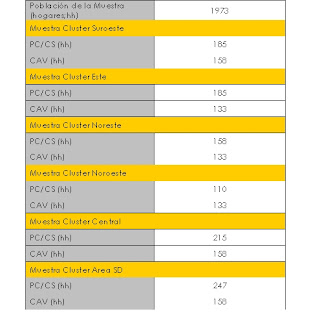
El censo en hogares será desarrollado en los clusters regionales, estratificadas en dos niveles:
i. población del sitio/comunidad de soporte (PS/CS)
ii. comunidades y asentamientos vecinos (CAV)

Condiciones de la Muestra
Grado de confianza 95%
Precisión 5%


ANALISIS DE DATOS*
* La completa descripción está en el reporte final.

REPORTE DE RESULTADOS Y ESTRATEGIA DE COMUNICACIÓN
Los resultados de la evaluación deberán ser reportados en tres fases:
i. Primer Reporte de Medio Término
ii. Segundo Reporte de Medio Término
iii. Reporte Final

Los Reportes de Medio Término serán dirigidos a:
· Miembros y personal del INDETUR
· Secretaría de Turismo
· Secretaría de Economía, Planificación y Desarrollo
· Ayuntamientos
· Organizaciones de la Sociedad Civil

Estos reportes deberán proveer sumarios con los principales hallazgos, dar descripciones cualitativas y cuantitativas sobre los cambios, y ofrecer comentarios sobre el proceso de evaluación en sí.

El Reporte Final deberá ser dirigido a las Instituciones mencionadas anteriormente. Este reporte debe ser desarrollado con profundidad, puntualizando en la magnitud de los cambios y en el análisis del marco socio-institucional. Debe también incluir comentarios y conclusiones sobre el establecimiento y funcionamiento del INDETUR.

Un sumario no técnico de estos Reportes debe ser escrito y distribuido abiertamente para el público general. Estos serán denominados Reportes Públicos y deben estar disponibles al mismo tiempo de la publicación de los Reportes de Medio Término y del Final.

Los Reportes Públicos deberán estar disponibles en el Internet.


CALENDARIO DE EVALUACIÓN*
*El calendario y la programación completa de la evaluación pueden encontrarse en el reporte final.

ANEXOS*
*Los anexos están presentes en el reporte final.
1. Mapa de Clusters
2. Análisis breve para muestra de censo de hogares
3. Bibliografía de base

How to Evaluate the potential INDETUR?

How To Evaluate The Potential Indetur?
From key concepts to a complex reality: INDETUR’s Evaluation Design

PREAMBLE

The Dominican Republic’s National Institute for Planning in Touristic Areas (INDETUR) is still uncertain. Nevertheless is necessary to think that after its possible establishment the relationship conditions between public sector, private sector, civil society and communities will change.

The content presented here is a summary of the Terms of Reference (ToR) design for an INDETUR’s Evaluation after its launching.

The full report was made for the “Project Monitoring and Evaluation” course, within the Master Urban Development and Reconstruction 07/08 at the IUAV University in Venice.


INTRODUCTION

Dominican Republic is the most important touristic destination in the Caribbean. The 20% of the economy rely on tourism, and probably the trickle down effect­ turns it into 36%. This value involves formal and informal economy. A boom in residential project building and real state has taken place in certain areas, especially the east and northeast, with millions of dollars allocated for exclusive private development.

Due to history and centralization, the macro-level planning is carried out by the Ministry of Tourism, who is greatly in charge of regulating land use and project approval within the areas declared as touristic by law. Other Ministries or Public offices involved in the process are: Municipalities (at times very rudimentary), the national coordinator for Municipalites (Liga Municipal Dominicana), and Ministry of Environment.

In recent years new changes have occur aiming at reorganizing the planning structure for the country. A new Ministry of Economy, Planning and Development have been created merging existing offices, and its interaction with other ministries is to be improved in the following years.

As an innovative initiative, a new Institute for Planning in Touristic Areas (Instituto Nacional para el Desarrollo Turístico, INDETUR) was proposed, and is now actually under final revision before approval by the Congress. This Institute would bring together the private sector into the planning process, as well as other Ministries and the National Water Agency. ASONAHORES (National Association of Hotels and Restaurants) and the National Association of Touristic Real State and Developers’ represent the private sector.

Even if some problems could begin, the public-private partnership proposal theoretically should bring improvements not only in the development of infrastructure for hotels, but also for the communities supporting the functioning of the tourism industry.


FRAMEWORK

The evaluation is to be carried out as an on going evaluation after the establishment of the Institute (formative evaluation type). The evaluation results can be then related to the public priorities and be compared within the national wage/expenses, within a period of time (summative evaluation type).

Evaluation Purpose

Recognizing the importance of tourism, this evaluation will provide the new INDETUR, the central Government and the society with the improvement data from the touristic areas’ communities in order to make the appropriate changes to the Institute and its relationship with other institutions and all the stakeholders.

Evaluation Questions*
* The indicators for each evaluation questions are listed in the complete design report.
Evaluation questions on:

Improvement on projects regularization and urbanization issues
1. To what extent the INDETUR improved the approval of projects?
2. To what extent the INDETUR produced or revised the touristic development plans and standards?

Public-private partnership interaction
1. To what extent the private and public sector are sharing the Institute’s responsibilities?
2. To what extent minor private entrepreneurs can participate in the Institute decision-making process?

Budget allocation
1. To what extent the Institute is favoring the least developed clusters?
2. To what extent the Institute is investing in compulsory infrastructure?

Communities’ involvement and life quality improvement
1. To what extent people and communities are being involved?
2. To what extent the quality of life has improved in each cluster?


METHODOLOGY

Sources
The primary data collection instruments and techniques are the following:
1. National and municipal government data from:
a. Ministry of Tourism
b. Ministry of Economy, Planning and Development
c. Municipalities
d. National Statistics Institute
e. Private and Civil Society Associations
2. Household surveys
3. Institute’s user surveys
4. Structured interviews and focus groups

Methods and Procedures*
* The full description of methods and procedures is available on the complete design report.

The national and municipal data
will be gathered and should record the figures since the establishment of the Institute until the end of the evaluation process.

The household surveys will be carried in the regional clusters, stratified in two strata:
i. on site population/ supporting communities (OnSP/SC)
ii. neighboring communities and settlements (NCS)

The first baseline survey will establish the socio-economic conditions of the inhabitants and villages against which subsequent changes can be evaluated. The survey should give the complete profile of the sampled villages with gender-disaggregated data.

Sampling Conditions

Confidence degree 95%
Precision 5%


DATA ANALYSIS*
* The full description is available on the complete design report.


RESULTS REPORT AND COMMUNICATION STRATEGY

The evaluation results shall be reported in three levels:
i. First Mid-Term Report
ii. Second Mid-Term Report
iii. Final Report

The Mid-Term Reports will be addressed to:
· INDETUR’s Members and Personnel
· Ministry of Tourism
· Ministry of Economy, Planning and Development
· Municipalities
· Civil society organizations

These reports will be progress-oriented, and should provide summaries of principal findings, qualitative and quantitative descriptions of socio-economic changes and comments on the evaluation process itself.

The Final Report shall be addressed to the Institutions mentioned previously. This report should be comprehensive and shall assess the extents of the changes and the society-institutional framework analysis. It shall also include comments and conclusions regarding the establishment of INDETUR.

A non-technical summary of the Reports shall be written for the general public and openly distributed. These would be named Popular Reports and shall be available at the same time of the Mid-Term and Final Reports.

The Popular Reports shall be available online.


TIMETABLE*
*The Timetable and evaluation plan is available on the complete design report.


ANNEXES*
1. Cluster’s Map
2. Household sampling assessment
3. Baseline bibliography

*All Annexes are available in the complete design report.

Cluster’s Map

junio 02, 2008

El Turismo de Sofá, por la variedad y el contacto


El turismo de sofá es una variante del turismo. El concepto es sencillo: pedir hospitalidad en el sofá de una persona, en un determinado lugar del mundo por una cantidad de días.

Esta idea introduce el contacto obligatorio entre dos partícipes, huésped y anfitrión, quienes pueden intercambiar entre sí cultura y experiencias.

El turismo de sofá permite una verdadera inmersión contemporánea, a diferencia del concepto clásico de turismo de inmersión. Esto se magnifica según el interés puesto por el anfitrión, quien funciona parcialmente como válvula reguladora de la experiencia del huésped, mostrándole el lugar, ayudando con sugerencias, compartiendo el tiempo libre, entre otras.

Desde el punto de vista económico el turismo de sofá no es sólo una opción de bajo presupuesto. A pesar del ahorro en gasto por alojamiento, que no resulta ser tan grande por el límite de días del huésped, el consumo de bienes alimenticios es regular y los gastos del día pueden variar según el huésped. Una diferencia clara es que el gasto no se realiza siempre bajo el libre albedrío, sino que –dada la ayuda del anfitrión y el gusto del huésped– se hace en sitios que no son los típicos comercios turísticos. Esto crea una distribución económica distinta, y que tiende a ser como el propio consumo de los habitantes locales.

En fin, a pesar de los criterios económicos y culturales, el turismo de sofá abre la posibilidad de adentrarse en una cultura/lugar a través de la casa de un local. Una opción sencilla y estimulante para el viajero de espíritu espontáneo.